
Blog
Do Office Plants Purify the Air?
The science of biophilia and workspace performance — and why the honest answer comes down to lighting.
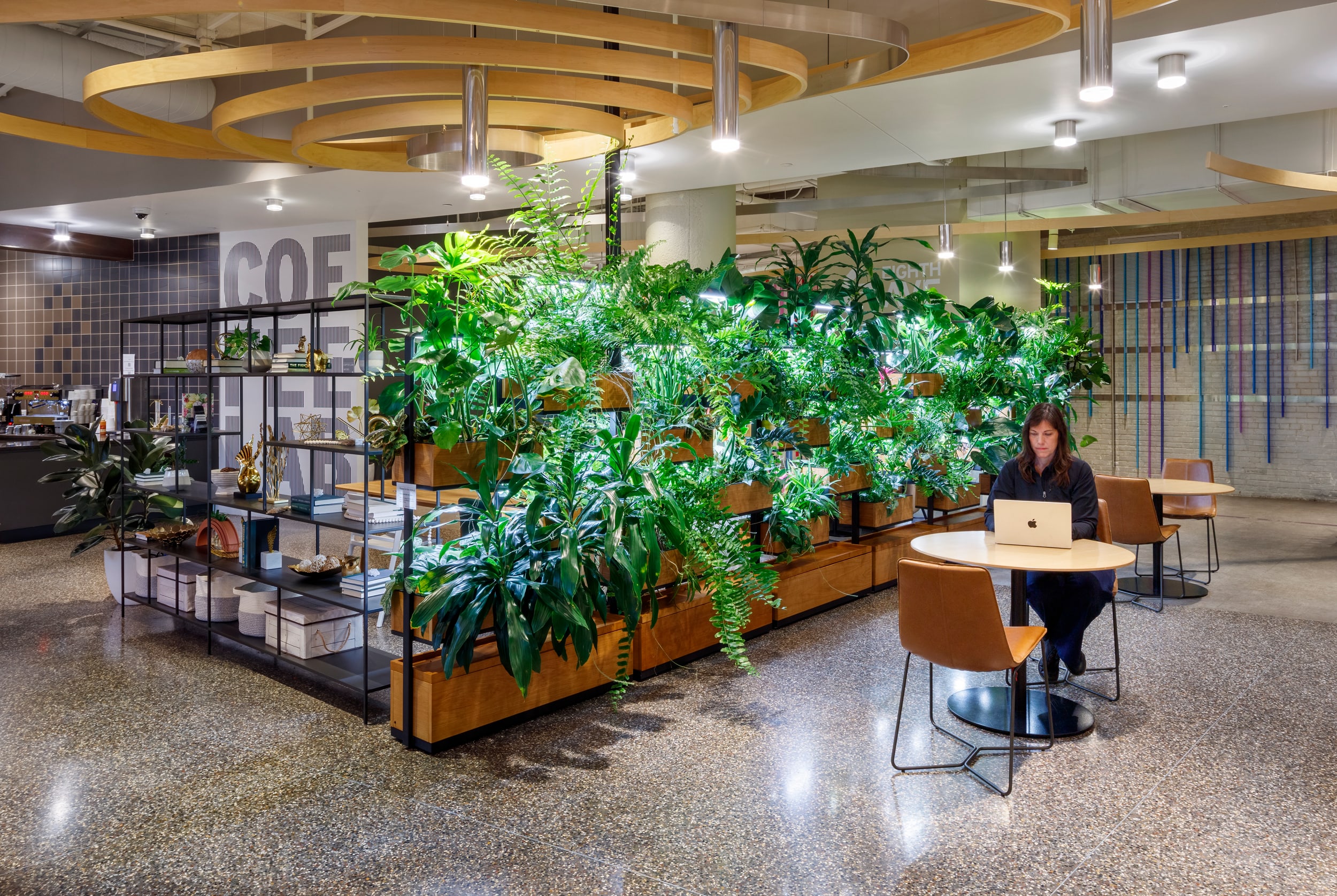
One of the most frequent questions facility directors and workplace designers ask us is: “Which plants are best for purifying office air?”
If you’ve researched this online, you’ve likely seen conflicting answers. Headlines range from touting plants as natural air filters to articles claiming their air-cleaning abilities are a complete myth.
The reality? It’s complicated — and it all comes down to lighting.
Many popular headlines claiming plants don’t purify air rely on studies that placed plants under poor, antiquated lighting, like standard office fluorescent bulbs. In reality, a plant’s ability to absorb carbon dioxide (CO2), release oxygen (O2), and scrub volatile organic compounds (VOCs) is directly proportional to the amount and quality of light it receives to drive photosynthesis.
Simply put: a few small potted plants sitting in a dark interior conference room will have a negligible impact on air chemistry. A thriving, well-lit botanical installation — supported by tailored spectrum lighting — has a measurable, positive impact on air quality, humidity, and oxygen levels.
Why we focus on the proven benefits
While air purification requires high light intensity — photon levels measured in µmol·m−2·s−1 — and specific plant density to be quantified, the broader cognitive, emotional, and physical benefits of plants in commercial spaces are universally proven.
This is why leading building frameworks like the WELL Building Standard and the Living Building Challenge prioritise biophilic elements. Rather than chasing outdated NASA study claims, forward-thinking companies integrate professional plantscapes for their impact on human performance, workplace wellness, and office culture.
The hard data
Integrating living design into corporate environments delivers measurable returns on employee satisfaction and operational performance.
Productivity and focus
A 15% increase in productivity. Research by the University of Exeter found that filling previously “lean” office environments with plants boosted employee productivity by 15%.
Attention restoration. According to Attention Restoration Theory, observing natural elements shifts the brain into a restorative processing mode, helping employees recover from mental fatigue and hold sharper focus.
Well-being and stress reduction
A study by the University of Technology, Sydney recorded significant psychological drops when plants were introduced to workspaces.
- 37%
- reduction in tension and anxiety
- 58%
- drop in depression and dejection
- 44%
- decrease in hostility
- 38%
- reduction in fatigue
The global Human Spaces Report surveyed 7,600 office workers across 16 countries and found that employees working in spaces with natural elements reported a 15% higher overall well-being score and a 15% higher creativity score.
Acoustic and environmental comfort
Acoustic dampening. Plants absorb and scatter high-frequency sound waves rather than letting them bounce off hard surfaces. Strategic placement along room perimeters and open plans helps quiet background office noise.
Humidity control. Research from the Royal Horticultural Society shows that plant transpiration raises relative humidity toward ideal human comfort levels. Proper ambient humidity reduces airborne dust, calms respiratory irritation, and improves overall workplace comfort.
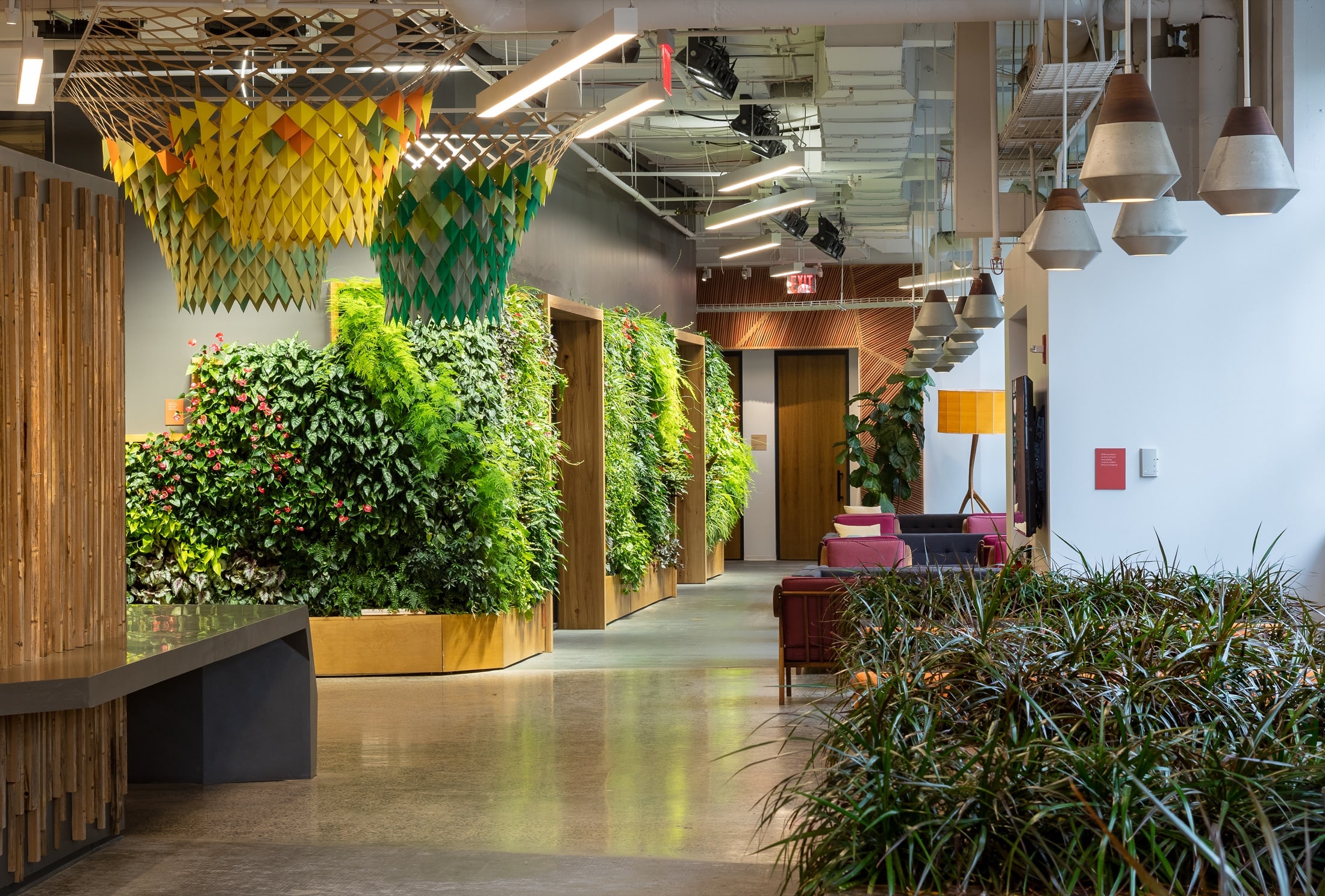
The secret to plant performance: architectural lighting design
At Greenery NYC we don’t just place plants in spaces — we engineer micro-ecosystems.
Because photosynthesis directly governs plant health, carbon capture, and longevity, getting the right light spectrum and intensity — measured in µmol — is paramount. This is why our design team works closely with architects and facility leads to integrate dedicated, aesthetic architectural grow lights into interior layouts.
Sufficient light ensures your commercial plantscapes don’t just survive; they actively thrive, continuously revitalising the workplace environment around them.
Collaborative design for high-performance workspaces
Relying on a few stray desk plants won’t transform your workspace culture or environment. To unlock the human, aesthetic, and performance return of biophilic design, commercial spaces require intentional layouts, precise light levels, and specialised horticultural care.
While we aren’t lighting designers ourselves, we frequently collaborate with top-tier architectural lighting design teams. Pairing our horticultural expertise with professional lighting layouts ensures your green infrastructure receives the exact spectrum and intensity in µmol needed to maximise growth, health, and biophilic benefit — the best outcome for both people and plants.
The question was never really which plant purifies the air. It is whether the space gives any plant enough light to do the work.
Designing for WELL, return-to-office, or both?
Greenery NYC brings the technical knowledge and ongoing maintenance required to make biophilic design perform — on your next commercial project and for years after it opens.
Work with us
Get in touch
Ready to bring the natural world into your space? Whether you need office plants, a living green wall, or a rooftop garden in New York City, Chicago, or Washington D.C. — we'd love to hear about your project.